This information is current as of August 6, 2026.
What are the influenza A requirements for bringing animals to the World Dairy Expo in 2026?
Highly Pathogenic Avian Influenza (HPAI) continues to be detected on dairy farms in the United States. As a result, a federal order requiring testing remains in effect but with changes as noted here. When testing is required, the required test for HPAI is an influenza A PCR, and testing details will refer to influenza A throughout this website.
A guidance document pertaining to the federal order from 2024 was updated April 2026. The updated guidance, effective April 27, 2026 allows the interstate movement of lactating dairy cattle from states with Unaffected state status under the National Milk Testing Strategy (NMTS) without individual cow influenza A testing. Check your state status.
Lactating dairy cattle arriving to Expo from states with Affected or Provisionally Unaffected state status continue to be required to have a negative influenza A test with a collection date no more than seven (7) days prior to movement. Check your state status.
World Dairy Expo also requires lactating dairy cattle traveling WITH cattle from states with Affected or Provisionally Unaffected state status to also have a negative Influenza A PCR test on milk samples with a collection date within seven (7) days of movement.
Wisconsin Summary Special Order 24-O-003 has been rescinded. Unless lactating dairy cattle are imported from states with Affected or Provisionally Unaffected state status under the NMTS, or are traveling WITH cattle from states with Affected or Provisionally Unaffected state status under the NMTS, dairy cattle are not required to be tested for influenza A prior to attending Expo. Check your state status.
Lactating dairy cattle from herds that have tested positive for influenza A are not eligible for interstate movement for 30 days following any positive influenza A test from the herd.
Only essential movements of dairy cattle are recommended. Premovement testing of nonlactating animals is not required for dairy cattle from any state.
For further information on HPAI influenza in cattle, including guidance and FAQs on the federal order and biosecurity, visit the DATCP web page on highly pathogenic avian influenza (HPAI) in dairy cattle.
What are the influenza A requirements for animals leaving World Dairy Expo in 2026?
Wisconsin does not have any requirements for cattle leaving Expo. Cattle can return to a location in Wisconsin without further testing.
The federal order effective April 29, 2024 with updated guidance effective April 2026, continues to allow lactating dairy cattle to return to the farm of origin without further testing after attending a show that is no longer than 10 days.
Lactating dairy cattle moving interstate to a new destination may be required to have a negative influenza A test with a collection date no more than seven (7) days prior to that interstate movement. Some states may also have requirements for influenza A testing to return to the farm of origin after Expo. Please contact the state of destination to learn more.
Testing to meet movement requirements will not be allowed on Expo grounds. Contact Expo to learn about options for early departures to accommodate cattle returning to states requiring additional testing.
Is there an example to demonstrate sample collection and movement dates to meet influenza A testing requirements for animals attending World Dairy Expo in 2026?![]()
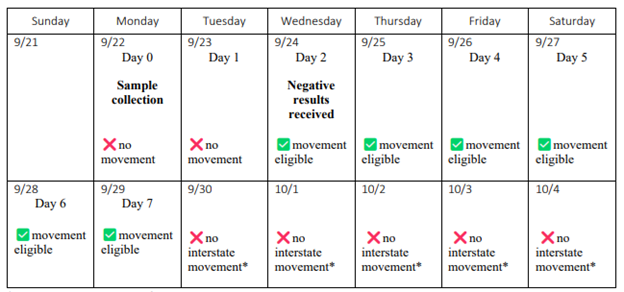
*Unless returning to origin farm without a change in ownership. Some states may also have requirements for influenza A testing to return to the farm of origin after Expo. Please contact the state of destination to learn more. See also FAQ Document on Lactating Dairy Cattle HPAI State Order.
Are there any requirements related to New World Screwworm (NWS)?
If animals originate in a state where New World Screwworm (NWS) has been identified, see additional requirements: NWS webpage or review below under "Do I need to get an import permit for my cattle?" To protect US livestock, DATCP recommends maintaining a heightened awareness in your animals for the larvae which are especially associated with wounds, including navels in newborns, and mucous membranes.
Are there requirements for bringing animals from within Wisconsin to the World Dairy Expo?
Yes. The state order requiring influenza A testing for Wisconsin cattle to attend fairs, shows, or other organized events for exhibitions has been rescinded. DATCP has no test or paperwork requirements for Wisconsin-origin cattle traveling within Wisconsin.
However, you will need to meet the entry requirements for the World Dairy Expo, which include arriving with a printed certificate of veterinary inspection (CVI, also known as a health certificate) that documents departure/shipping date from the farm, an inspection date within 30 days of arrival at Expo, and official animal identification.
For Wisconsin-origin cattle that have traveled to Michigan's federal Modified Accredited zone (Alpena, Alcona, Montmorency, and Oscoda counties) within 90 days prior to the start of the Expo, please call (608) 224-4874 between 7:45 a.m. and 4:30 p.m. Monday through Friday to learn more.
Are the World Dairy Expo's testing and ID requirements the same as Wisconsin's import requirements?
The World Dairy Expo may have additional requirements beyond what Wisconsin requires. For more information on the World Dairy Expo's specific requirements, please consult the premium book.
May I bring in cattle from outside the United States?
Yes. You must meet the import requirements established by the USDA for your animals to attend the World Dairy Expo. You can learn more about importing cattle from other countries by visiting USDA's live animal import website. Choose the country of origin and the type of cattle.
Wisconsin Summary Special Order 24-O-003 has been rescinded. Wisconsin does not require lactating dairy cattle from outside the United States to be tested for influenza A prior to attending Expo. Cattle may have additional requirements to return to their country of origin, including requirements for influenza A testing for lactating dairy cattle. You can find more information at USDA's live animal export website. Choose the country of destination, species, and type of cattle.
You can also reach USDA Live Animal Import and Export by calling (301) 851-3300 and selecting option 2.
Have the official identification requirements changed?
The official ID requirements are the same as last year. USDA visual only 840 tags are only acceptable as official ID if they were applied prior to November 5, 2024.
Acceptable forms of ID for 2026 are:
- USDA 840 RFID tag (The official numbers on these tags contain 15 digits with the first three being 840)
- Canadian 124 RFID tags (The official numbers on these tags contain 15 digits with the first three being 124)
- If applied prior to November 5, 2024, USDA 840 visual only tags
- The World Dairy Expo has information on what forms of identification will be accepted.
Do all ID tags have to be RFID?
No. World Dairy Expo will accept visual forms of USDA 840 tags as noted above.
Are there special import rules for cattle from Michigan?
Yes. There are two sets of regulations for importing cattle from Michigan. One set is for the federal Modified Accredited (MA) zone consisting of the following counties: Alcona, Alpena, Montmorency, and Oscoda. The other set of rules applies to the rest of the state, which is the federal TB-free zone.
May I sell cattle from Michigan at the World Dairy Expo?
For cattle from the counties in the federal Modified Accredited (MA) zone (Alcona, Alpena, Montmorency, and Oscoda), the previous restrictions are still in place. Cattle from the MA zone may be sold at the World Dairy Expo ONLY if the animals return to their state of origin after the Expo and then travel to the new owner on a new certificate of veterinary inspection (CVI or health certificate). Make sure the animals meet the import requirements of the state of destination.
Cattle from the counties in the federal TB-free zone may be sold at the World Dairy Expo as long as they meet Wisconsin import requirements and the Expo's requirements for sale as described in the premium book.
Do I need to get an import permit for my cattle?
You will need a permit in certain circumstances as outlined below:
- Yes, if you are bringing cattle from a New World Screwworm (NWS) Infested Zone in a New World Screwworm affected state. Requirements: NWS webpage.
- Yes, if you are bringing cattle from Michigan's Modified Accredited zone (Alcona, Alpena, Montmorency, and Oscoda counties).
- No, if you are from Michigan's federal TB-free zone or Texas and your animals meet the import requirements for your state and are NOT part of a TB-positive or exposed herd investigation. If the animals are part of a TB-positive or exposed herd investigation, they are not eligible to enter Wisconsin.
- No, if you are from areas/states other than that listed in point 1 above, or you are from Canada, you do not need an import permit issued by Wisconsin.
I'm bringing in cattle from a New World Screwworm (NWS) Infested Zone or from Michigan's MA zone, so I need an import permit. How do I get one?
- This is usually done by the veterinarian for the exhibitor.
- Access the online import permit application form and follow the instructions. Alternatively, you can print the import permit application form and follow the directions provided.
- Fill the form out completely; all boxes with an asterisk are required.
- You need to include the livestock premises code for the Alliant Energy Center, which is 004A6S7. (Thanks again to the Alliant Energy Center staff for letting us post the number here.) Import permits without the livestock premises code will not be processed.
- The "applicant" who signs the form can be the owner, or it can be the veterinarian or someone from the veterinary clinic staff - it doesn't have to be the owner of the animal(s).
- When the form is completed, submit it along with the signed and dated CVI (health certificate). If using the online form, CVIs can be attached during the submission process. If using a printed paper form, the form and CVI can be emailed or faxed to DATCPanimalimports@wisconsin.gov or (608) 224-4871.
- When everything is in order, a Wisconsin state veterinarian will issue a permit number, and the permit number will be emailed or faxed back (or phoned, if requested). The permit number must be written on the CVI.
If you have trouble with the process, call the Wisconsin Division of Animal Health import coordinator at (608) 224-4874 Monday through Friday from 7:45 a.m. to 4:30 p.m. Import permits are processed Monday through Friday from 8 a.m. to 4 p.m.
How long are import permits good?
As long as the test results and Certificate of Veterinary Inspection (CVI, also known as a health certificate) are current, an import permit is good for 30 days from the date it is issued.
How long does it take to get an import permit?
Once all the required information has been received, an import permit is usually issued the same day. As the deadline gets closer, however, the turnaround time gets longer, so plan ahead.
When is the best time to apply for an import permit?
While import permits for the World Dairy Expo can be processed at any time starting 30 days before your arrival date in Wisconsin, an excellent time to get in your application is the two-week period between 21 and seven days before the start of the World Dairy Expo. Waiting until the last few days is not recommended. We strongly discourage applicants from se nding in a permit request the same day the exhibitor wants to leave. The application process takes time, and there may be people in line ahead of you.
How much does an import permit cost?
DATCP does not charge a fee for cattle import permits.
Can you answer questions about World Dairy Expo fees, facilities, or entry information?
No. Please visit the World Dairy Expo website or call (608) 224-6455 for answers about the Expo itself.
Resources
World Dairy Expo Premium Book
World Dairy Expo
FAQ Document on Lactating Dairy Cattle HPAI State Order