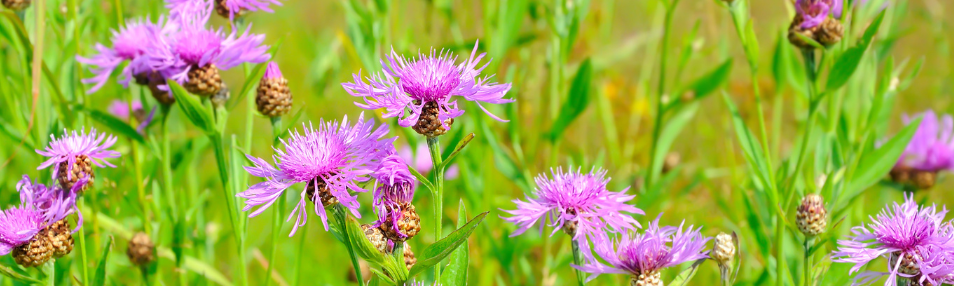
A Wisconsin 414 permit is required for inter- and intrastate movement and environmental release of biological control agents and regulated plant pests. The permitting process helps safeguard Wisconsin’s unique environments from injurious pests. It allows for consideration of elements specific to our state, such as the impact certain organisms could have on endangered species. It also provides flexibility to make decisions based on the most current research and enables us to track releases over time.
Exemptions to the Wisconsin 414 Permit
There are several exemptions outlined in
ATCP 21.04(2):
- Any biological control agent which is endemic to the state, provided the agent is not restricted by a federal or state rule or quarantine order.
- Any agricultural, horticultural, or silvicultural plant that suppresses or controls plant pests or pathogens, provided it has not been declared a pest under state or federal law.
- Pesticides registered by the Environmental Protection Agency or DATCP.
- Pesticides distributed or used under an experimental use permit issued by DATCP.
Organisms No Longer Requiring a Wisconsin 414 Permit
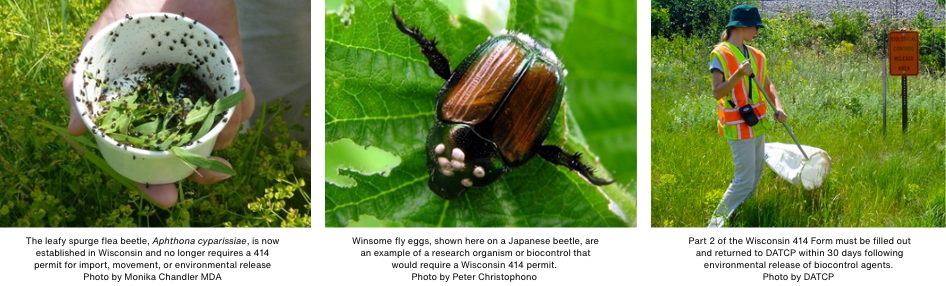
Select organisms introduced for biological control of emerald ash borer, leafy spurge, purple loosestrife and spotted knapweed that have been repeatedly released in the state for 10 years or more without harmful impacts to non-target species no longer require a Wisconsin 414 Permit. Below is a list of approved organisms that may be released in the state without applying for a 414 Permit.
Oobius agrili
| Emerald Ash Borer
| Agrilus planipennis
|
Spathius galinae
| Emerald Ash Borer
| Agrilus planipennis |
Tetrastichus planipennisi
| Emerald Ash Borer
|
Agrilus planipennis |
Aphthona cyparissiae
| Leafy Spurge
|
Euphorbia esula |
Aphthona czwalinae
| Leafy Spurge
|
Euphorbia esula |
Aphthona flava
| Leafy Spurge
|
Euphorbia esula |
Aphthona lacertosa
| Leafy Spurge
|
Euphorbia esula |
Apththona nigriscutis
| Leafy Spurge
|
Euphorbia esula |
Oberea erythocephala
| Leafy Spurge
| Euphorbia esula
|
Spurgia esulae
| Leafy Spurge
| Euphorbia esula
|
Galerucella calamarensis
| Purple Loosestrife
| Lythrum salicaria
|
Galerucella pusilla
| Purple Loosestrife
| Lythrum salicaria
|
Hylobius tranversovittus
| Purple Loosestrife
| Lythrum salicaria
|
Nanophyes marmoratus
| Purple Loosestrife
| Lythrum salicaria
|
Agapeta zoegana
| Spotted Knapweed
| Centaurea stoebe
|
Bangasternus fausti
| Spotted Knapweed
|
Centaurea
stoebe |
Cyphocleonus achates
| Spotted Knapweed
|
Centaurea
stoebe |
Larinus minutus
| Spotted Knapweed
| Centaurea
stoebe
|
Larinus obtusus
| Spotted Knapweed
| Centaurea stoebe
|
Metzneria paucipunctella
| Spotted Knapweed
| Centaurea
stoebe
|
|
Sphenoptera jugoslavica | Spotted Knapweed
| Centaurea stoebe
|
|
Urophora affinis | Spotted Knapweed
| Centaurea
stoebe
|
Urophora quadrifasciata
| Spotted Knapweed
| Centaurea stoebe
|
*This list does not contain organisms that are native to Wisconsin.
How to Request a Wisconsin 414 Permit
Steo One: Fill out
Wisconsin 414 Permit Part 1 (Word or PDF)
Importing or Moving Live Plant Pests or Biological Control Agents
Mail, email, or fax the completed form to:
Department of Agriculture, Trade and Consumer Protection
ATTN: Stephanie Jentz DARM
P.O. Box 8911
Madison, WI 53708-8911
Phone: (608) 347-1082
Fax: (608) 224-4871
Email: stephanie.jentz@wisconsin.gov
Step Two: If the permit is for biological control releases, you must also
fill out
Wisconsin 414 Permit Part 2 (Word or PDF)
Mail, email, or fax the completed form to the address above.
Documentation of the Release of Plant Pests or Biological Control Agents within 30 days
following the release of approved biological control agents.
Other Permits You May Need
To hand carry, ship, or transport regulated organisms and biocontrol agents into the state of Wisconsin, a federal USDA Plant Protection and Quarantine permit, called a PPQ 526 permit, is required. To move organisms within the state or to release biological control organisms into the environment, a Wisconsin 414 permit is required.
For example, a PPQ 526 permit is needed for a commercial supplier to ship biological control organisms across state lines. Similarly, a researcher requesting to import plant pests or biocontrol organisms from another state into Wisconsin must also obtain a permit.
If a person residing in Wisconsin is purchasing biological control organisms from a supplier in another state, the supplier is responsible for obtaining the PPQ 526 permit and the Wisconsin recipient releasing the organisms in the state is responsible for obtaining a Wisconsin 414 permit.
Origin of Plant Pest of Biocontrol Agent
| Permit Needed
|
Outside of United States
| PPQ 526 and Wisconsin 414 Permit
|
Outside of Wisconsin
| PPQ 526 and Wisconsin 414 Permit
|
Inside of Wisconsin
| Wisconsin 414 Permit
|
PPQ 526 Permit Information
A Plant Protection and Quarantine (PPQ) 526 permit is required for the importation, interstate movement, and environmental release of plant pests (plant feeding insects, mites, snails, slugs; and plant pathogenic bacteria, viruses, fungi, etc.), biological control organisms of plant pests and weeds, bees, parasitic plants, and federally listed noxious weeds.
PPQ 526 permit application materials and information can be found here:
Regulated Organism and Soil Permits | Animal and Plant Health Inspection Service.
Wisconsin 414 Permitting Authority
The following state statute and administrative rule govern Wisconsin's Plant Pest and Biocontrol Permit Program:
Statute 94.03 pertains to the shipment of pests and biological control agents and permits. In summary, Statute 94.03 states that no person may sell or offer for sale, or move, transport, deliver, ship or offer shipment of any pest or any biological control agent without a permit, and that the department may by rule regulate biological control agents to assure their safety and effectiveness in the control of injurious pests and to prevent the introduction or use of biological control agents which may be injurious to persons or property or useful plant or animal life.
ATCP 21.04 pertains to pests and biological control agents and the permit to move or release them. In summary, ATCP 21.04 states that a permit is required to import, move or distribute, and release any live pest lifestage or biological control agent in the state of Wisconsin. It also lists exemptions, conditions, and limits permit application processing to 30 business days once a completed application is filed with the department.
<<Back to main pests and diseases page