This serious animal health threat is not currently found in Wisconsin. Access the Summary Special Order regarding the import of domestic warm-blooded animals from states with active New World Screwworm infested zones. Sign up for updates from DATCP.
New World Screwworm (Cochliomyia hominivorax/NWS) is a parasitic fly whose larvae feed on living tissue. After being eradicated from the U.S. in 1966, NWS has re‑emerged in Central America and Mexico. According to the U.S. Department of Agriculture (USDA), NWS has been detected in the U.S. and in animals near the U.S.-Mexico border. USDA is working with affected states to respond with sterile fly releases, surveillance, and movement controls.
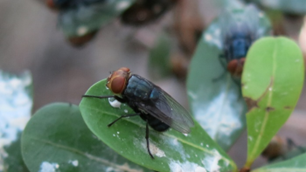
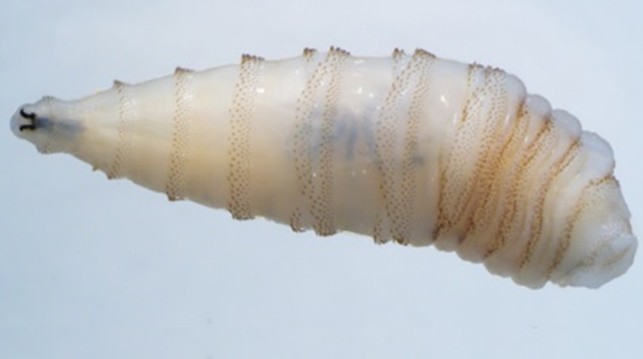
Fig. 1 NWS Adult | Fig. 2 NWS Larvae
On July 14, 2026, DATCP issued a temporary movement order modifying the import movements of domestic warm‑blooded animals from states with active NWS‑infested zones. This order, which went into effect on July 21, 2026, outlines additional requirements for animals originating from or moving through affected areas, including Certificates of Veterinary Inspection (CVIs), inspection statements, treatment details, and DATCP‑approved permits when applicable. Access the release. Access the order.
Why It Matters for Wisconsin
Wisconsin receives animals from southern states where NWS risk is highest. Any warm‑blooded animal with an open wound can be affected, including pets, livestock, wildlife, and people. Early detection prevents severe, sometimes fatal, infections.
Who Is at Risk
- Dogs, cats, cattle, horses, swine, sheep, goats, and birds
- Wildlife and imported/illegally trafficked animals
- Humans with untreated wounds or recent travel to affected regions
- Animals recently transported from southern states or countries
Signs to Watch For
- Painful, enlarging, draining, foul‑smelling wounds
- Larvae burrowed deep in tissue (not on the surface like typical maggots, and wounds can be infested with multiple maggot species)
- Sudden discomfort, agitation, or behavior changes in animals
What You Can Do
For Pet and Livestock Owners, Markets, and Dealers
- Inspect animals after travel or intake
- Seek veterinary care for suspicious wounds
- Avoid transporting animals from outbreak areas without inspection
- Maintain compliance with quarantine and inspection requirements
For Shelters and Rescues
- Train staff to recognize NWS
- Inspect all incoming animals, especially from southern regions
- Report suspected cases immediately to DATCP
- Maintain compliance with quarantine and inspection requirements
For Veterinarians
- Review NWS identification and reporting protocols
- Report suspected cases to DATCP
- Use USDA, Food and Drug Administration (FDA), and Centers for Disease Control (CDC) resources for diagnostics, treatments, and training
- Complete NVAP Module 41 on NWS
Animal Movement
In response to cases of New World Screwworm (NWS) in the southern U.S., Wisconsin issued a Summary Special Order effective July 21, 2026 with additional requirements for warm-blooded animals moving from states with active NWS infested zones.
Animals NOT located in an active NWS infested zone
For states with active NWS infested zones, veterinarians writing Certificates of Veterinary Inspection (CVI) for domestic, warm-blooded animals imported into Wisconsin from those states, but NOT originating from an active NWS infested zone, shall include a statement indicating that the animals do not originate from an active NWS infested zone. Current USDA information on active NWS zones can be found at Screwworm.gov.
Animals located in an active NWS infested zone
For states with active NWS infested zones, animals originating from active NWS infested zones must comply with all State and Federal requirements including quarantine and inspection prior to movement. Current USDA information on active NWS zones can be found at Screwworm.gov.
Domestic warm-blooded animals originating from NWS infested zones, shall not be imported into Wisconsin unless all of the following are met:
- The Department has approved an import permit for the animals at least 48 hours prior to movement. An import permit may be requested by completing this form: https://wi.accessgov.com/datcp/Forms/Page/dah/nwsimportpermitapplication/.
- The CVI for the movement includes a statement indicating that the animals originate from a location in an NWS infested zone.
- The CVI includes a statement indicating that the animals to be moved were inspected within 5 days of the movement date, by an authorized inspector, and that there is no visual evidence of NWS.
- If treatment was administered, such as an NWS animal drug or pesticide, the CVI includes a statement indicating the type, dose, route, and date(s) of treatment.
Is This a Food Safety Issue?
No, NWS is not a food safety issue. NWS larvae feed on living tissue in animals, but they do not contaminate meat or other foods during processing. Additionally, according to the USDA Federal Meat Inspection Act, animals used for human food production must pass inspection before slaughter and after slaughter to ensure food safety and humane handling requirements are met.
NWS Communications
July 14, 2026: Wisconsin Modifies Import Requirements from States with Active NWS | NWS Updates for Wisconsin
June 2026: New World Screwworm Resource Update
June 2026: New World Screwworm: What Wisconsin Needs to Know
September 2025: New World Screwworm: Information for Farmed Deer Producers
July 2025: What Shelters Should Know about New World Screwworm
December 2024: New World Screwworm (NWS) Awareness for Veterinarians